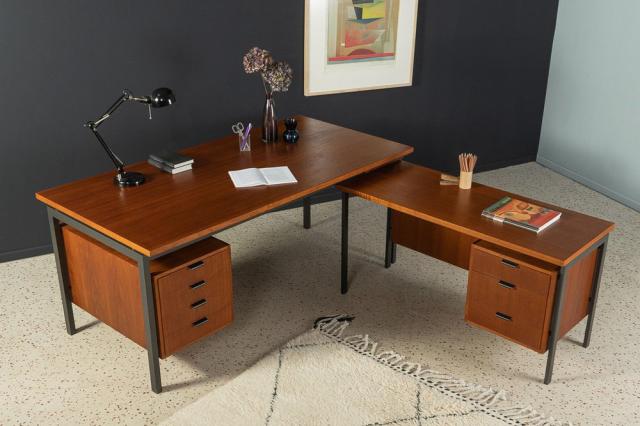
This piece of furniture, dating from the transitional period between Art Deco and the Bauhaus, was designed by Bruno Paul, architect, designer, and artist.
It was produced around 1930 at the VEB Hellerau Workshops in Dresden.
The piece was crafted from high-quality woods. Bruno Paul’s designs are distinguished by their unmistakable architectural character. The construction is defined by clearly articulated horizontal and vertical lines, making this piece a true statement piece of furniture. Depending on the incidence of light, the colour varies from different shades of brown and light brown to subtle reddish nuances.
This Bruno Paul piece combines material and function in an impressive and highly artistic manner. Its construction, distinguished by a unique approach to the choice of materials, proportions, and details, is characterised by simple, precise connections and reflects outstanding craftsmanship.
These modern and timeless pieces can be effortlessly integrated into a wide variety of interior styles, ranging from elegant to extravagant, and create a distinctive focal point in any interior.
The surfaces have been professionally restored, with particular attention paid to preserving the original substance, the historical appearance, and the authentic character of the piece.
Bruno Paul, who worked as an architect, furniture designer, and caricaturist, began his artistic training in Dresden. In 1891, he moved to Munich, where he successfully completed his studies at the Academy of Fine Arts. In 1897, Bruno Paul, together with Bernhard Pankok, Hermann Obrist, and Richard Riemerschmid, founded the “Münchner Werkstätten für Kunst im Handwerk” (Munich Workshops for Arts and Crafts).
Bruno Paul’s furniture designs were inspired by Henry van de Velde. His pieces are characterised by simple, clear forms. from February 1897 onwards, Bruno Paul contributed caricatures to the magazine Simplicissimus, a satirical publication founded in Munich in 1896 by publisher Albert Langen and painter Thomas Theodor Heine. By 1905, he had created various exhibition interiors as well as the waiting room at Nuremberg Central Station.
In 1907, Bruno Paul took over the directorship of the Berlin School of Arts and Crafts and worked as an architect in Berlin. Further architectural projects followed, accompanied by increasing international recognition of his work.
Bruno Paul was also one of the founders of the Deutscher Werkbund. At the Werkbund Exhibition of 1914 in Cologne, he was represented by three buildings: the Yellow House, the Wine House, and the Brewery. Bruno Paul later became director of the School of Arts and Crafts in Berlin. In the years that followed, he achieved international recognition, particularly for his architectural work and his activities as a designer.





Get in Touch
Make An Offer
We noticed you are new to Pamono!
Please accept the Terms & Conditions and Privacy Policy
Get in Touch
Make An Offer
Almost There!
To follow your conversation on the platform, please complete the registration. To proceed with your offer on the platform, please complete the registration.Successful
Thanks for your inquiry, someone from our team will be in touch shortly
If you are a Design Professional, please apply here to get the benefits of the Pamono Trade Program